Best time to visit Sri Lanka, region by region
Sri Lanka has two monsoons, so one coast is usually dry. Here is when to visit the south and west coast, hill country, Cultural Triangle, east coast, Jaffna and Yala, with a month-by-month table and the festivals worth planning around.
By VisitLanka teamUpdated 10 min read
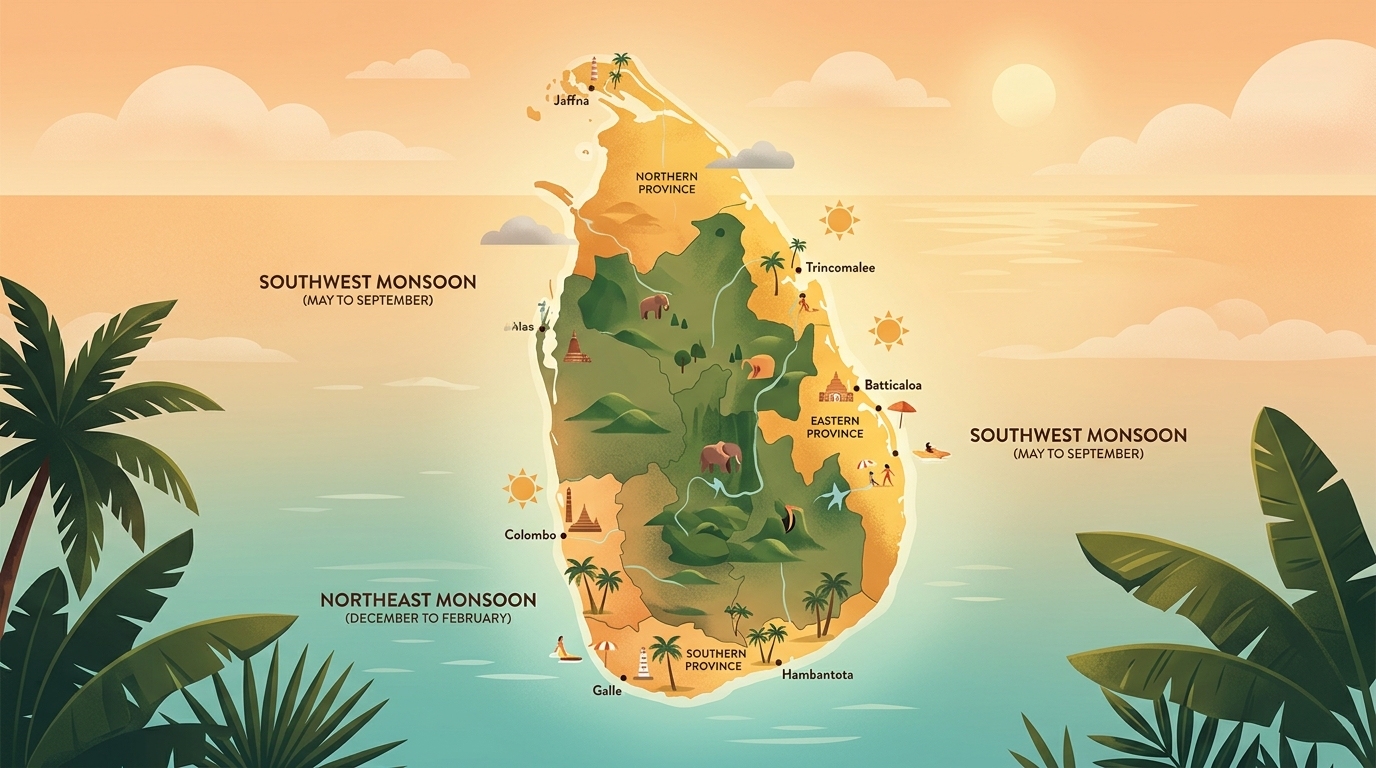
The best time to visit Sri Lanka depends on which coast you want. For the south and west coast and the hill country, go from December to March. For the east coast, including Trincomalee and Arugam Bay, go from May to September. The Cultural Triangle in the middle works for most of the year. The island has two monsoons that hit opposite sides at different times, so some part of it has good weather in every month.
| Region | Best months | Wettest months | Good for |
|---|---|---|---|
| South and west coast (Galle, Mirissa, Bentota, Colombo) | December to March | May to July, October to November | Beaches, whale watching, Galle Fort |
| Hill country (Kandy, Nuwara Eliya, Ella) | January to April | May to August on the western slopes, October to December around Ella | Tea country, hiking, train journeys |
| Cultural Triangle (Sigiriya, Dambulla, Anuradhapura, Polonnaruwa) | January to September | October to December | Ancient cities, the Minneriya elephant gathering |
| East coast (Trincomalee, Pasikudah, Arugam Bay) | May to September | November to January | Calm sea, surfing, snorkelling |
| North (Jaffna) | February to September | October to December | Tamil culture, temples, islands |
| South-east wildlife (Yala, Udawalawe) | February to July | November to January | Leopards, elephants, birds |
How do Sri Lanka's two monsoons work?
The Department of Meteorology splits the year into four seasons. The southwest monsoon runs from May to September and drops most of its rain on the west coast, the south coast and the western side of the hills. The northeast monsoon runs from December to February and mainly wets the north and east. Between them sit two inter-monsoon periods, March to April and October to November, when thunderstorms can build anywhere on the island.
Two things catch first-time visitors out. October and November are often the wettest months island-wide, which makes them the least predictable time to travel. And November to December is cyclone season in the Bay of Bengal, which can bring days of heavy rain and flooding to the east and north.
Monsoon rain rarely means grey skies all day. It usually arrives as a heavy burst in the afternoon or overnight, with clear spells in between. The sea is the bigger problem. On whichever coast is in monsoon, red flags go up, swimming gets dangerous and most boat trips stop.
South and west coast: December to March
The beaches between Colombo and Tangalle are at their best from December to March. Expect flat sea, sunny days and calm water off Mirissa for whale watching, with blue whales most reliably seen off the south coast from roughly November to April. Sunset on the ramparts of Galle Fort is at its best in this window too. The catch is that it's also when the coast is busiest, and rooms fill up fast over Christmas and New Year.
April is hot and humid, with more afternoon storms. From May to September the southwest monsoon brings rough sea and onshore wind. Some beach guesthouses close and most whale-watching boats stay in harbour. Galle and Colombo still work as city stops in these months, but this isn't beach season on this side of the island.
Hill country: January to April
Kandy, Nuwara Eliya and Ella sit between roughly 500 and 1,900 metres, so they're cooler than the coast all year. January to April gives the clearest mornings. That matters at Horton Plains National Park, where World's End is often lost in cloud by mid-morning, and on the Kandy to Ella train, where mist can hide the tea estates you came to see.
The hills don't share one season. The western slopes around Hatton, Nuwara Eliya and Kandy take heavy rain from May to August. Ella and Haputale sit on the eastern side, so they stay drier in those months and get their main rain from October to December instead. If you're travelling in July, Ella is the better hill base.
Adam's Peak (Sri Pada) keeps its own calendar. The pilgrimage season starts on the Unduvap full moon in December and ends on Vesak in May. In season the path is lit all night and the tea stalls on the steps are open. Outside it, the summit is often in cloud, the path is dark and you'll need a torch.
Cultural Triangle: January to September
Sigiriya, Dambulla, Anuradhapura and Polonnaruwa are in the dry zone, so they get far less rain than the hills and the southwest. Most of the year is fine here. The wet spell is roughly October to December, when the inter-monsoon storms and the northeast monsoon arrive.
June to September is dry and very hot. Climbing Sigiriya Rock at midday in August is hard work, with little shade on the upper steps. The same dry spell pulls wild elephants to the shrinking reservoir in Minneriya National Park. Hundreds can gather on its grassy shore between July and October, with August and September usually the strongest months.
East coast: May to September
When the southwest is wet, the east coast is at its best. Trincomalee, Nilaveli, Uppuveli and Pasikudah have calm, clear water from about May to September, and snorkelling trips to Pigeon Island run in this window. Boats also go out from Trincomalee to look for whales and dolphins, though sightings are less predictable than off Mirissa in winter.
Arugam Bay is Sri Lanka's best-known surf spot, with the main season running from roughly May to October. July and August are the busiest weeks. From November to January the northeast monsoon makes the east coast wet and windy, and many places in Arugam Bay shut for a few months.
The north: February to September
Jaffna is hot and dry for most of the year, with its rain concentrated from October to December. February to April is warm but comfortable. June to September is very hot, but it's also when Jaffna holds its biggest event, the 25-day festival at Nallur Kandaswamy Temple, which usually falls in August and early September. Dates follow the Tamil calendar. Men remove their shirts before entering the temple and everyone leaves their shoes outside.
Yala and Udawalawe: February to July
Yala National Park is open most of the year, but the dry months from February to July usually give the best sightings, as animals gather at fewer water holes and the scrub thins out. Leopards are the reason most people come. Udawalawe is the more reliable park for elephants and works well all year.
Plan around the closures. The Department of Wildlife Conservation shuts Yala's busiest blocks for a spell in most dry seasons. In 2026, Blocks 1 and 2 closed from 14 September to 15 October because of drought and heat stress, while the other blocks stayed open. Parks can also close at short notice in very heavy rain, as Yala, Horton Plains, Minneriya and several others did in late November 2025.
Want to see which of these regions fit your travel dates side by side? Add them to your trip plan and see them on one map: Start planning your trip.
Month by month: where to go
| Month | Best regions | Weaker regions |
|---|---|---|
| January | South and west coast, hill country, Cultural Triangle | East coast, north |
| February | Almost everywhere, one of the best months overall | Some lingering showers in the east |
| March | South and west coast, hill country, Cultural Triangle, Yala | Afternoon storms start to build |
| April | Hill country, Cultural Triangle, Yala | Storms anywhere in the afternoon, busy holidays mid-month |
| May | East coast, Cultural Triangle, Ella | South and west coast, Kandy |
| June | East coast, Cultural Triangle, Jaffna | South and west coast |
| July | East coast, Cultural Triangle, Ella, Jaffna | South and west coast |
| August | East coast, Cultural Triangle, Kandy for the Perahera | South and west coast |
| September | East coast, Jaffna, Minneriya | South and west coast, Yala closures |
| October | No region is reliable | Wet spells island-wide |
| November | South coast from late in the month | East and north, cyclone risk |
| December | South and west coast, hill country, Adam's Peak | East coast, north |
Festivals and holidays that change your plans
Every full moon (Poya) is a public holiday. Alcohol isn't sold and some bars and restaurants close, so if you want a beer with dinner, buy it the day before.
The Sinhala and Tamil New Year (Aluth Avurudu) falls on 13 and 14 April. Many shops and family-run guesthouses close for a few days, and buses and trains fill up as people travel home to their villages. Nuwara Eliya has its busiest weeks of the year around then.
Vesak, on the May full moon, is the best night of the year to be in Colombo or Kandy. Streets fill with paper lanterns, lit pandals and dansal stalls handing out free food and drinks to anyone passing.
The Kandy Esala Perahera is ten nights of processions around the Temple of the Sacred Tooth Relic (Sri Dalada Maligawa), usually in July or August. In 2026 it ran from 18 to 28 August. Dates follow the lunar calendar, and Kandy hotels book out months ahead, so lock in your stay as soon as the temple announces them.
Christmas and New Year is peak season on the south coast. Book rooms and drivers well ahead if you're travelling then.
Is monsoon season a bad time to visit?
Not if you pick the right side. From May to September, a route through the Cultural Triangle, Kandy, Ella and the east coast avoids most of the southwest monsoon, with fewer crowds than in winter. The same logic works in reverse from December to March.
The months we'd be careful with are October and November, when neither coast is reliable. If you can only choose one month, we'd pick February. The south and west are dry, the hills are clear, the Cultural Triangle is comfortable and the east is drying out.
Frequently asked questions
What is the best month to visit Sri Lanka?
February is the safest single month. The south and west coast, the hill country and the Cultural Triangle are usually dry, and the east coast is coming out of its wet season. January and March are close behind.
When is the rainy season in Sri Lanka?
There are two. The southwest monsoon brings rain to the west, south and western hills from May to September, and the northeast monsoon brings rain to the north and east from roughly November to February. October and November often bring heavy storms island-wide.
What is the best time to visit Sri Lanka for beaches?
Go to the south and west coast, around Galle, Mirissa and Bentota, from December to March. Go to the east coast, around Trincomalee, Pasikudah and Arugam Bay, from May to September.
When is the best time for whale watching in Sri Lanka?
Mirissa on the south coast is best from roughly November to April, when blue whales are seen most reliably. Trincomalee has trips in the east coast season, roughly May to September. Choose an operator that keeps its distance from the whales and limits how many boats crowd one animal.
Is October a good time to visit Sri Lanka?
It's the least predictable month. Storms can hit anywhere, usually in the afternoon, and Yala's busiest blocks may still be closed in the first half of the month. It can work if you're flexible and plan mornings for sightseeing, but don't build a beach holiday around it.
Is Sri Lanka too hot in summer?
The coast stays around 27 to 31°C all year, so it's humid rather than extreme. The dry zone, including Sigiriya, Anuradhapura and Jaffna, gets very hot from June to September. The hills stay mild, which is why many travellers spend more time in Kandy, Nuwara Eliya and Ella at that time of year.
Save the regions that suit your dates, add a driver for the long transfers and send enquiries straight to local businesses from your itinerary: Plan your Sri Lanka trip on VisitLanka.