UNESCO World Heritage sites in Sri Lanka: all 8 explained
Sri Lanka has eight UNESCO World Heritage sites, from Sigiriya and the Cultural Triangle to Galle Fort, Sinharaja and the Central Highlands. Here's what each one is, how long it needs and how to visit.
By VisitLanka teamUpdated 10 min read
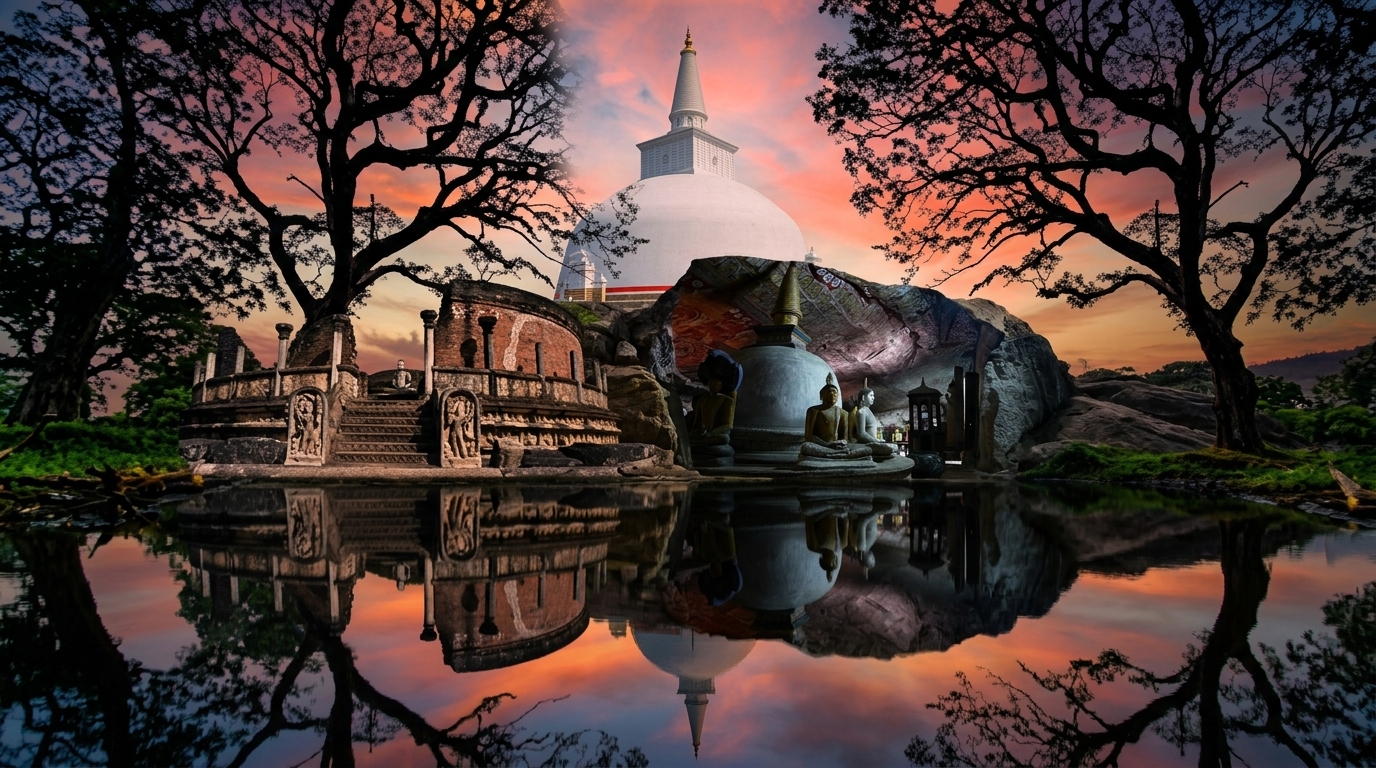
Sri Lanka has eight UNESCO World Heritage sites: six cultural and two natural. Four of them, Anuradhapura, Polonnaruwa, Sigiriya and Dambulla, sit close together in the Cultural Triangle in the dry north-central plains. Kandy is the gateway to the hills, Galle Fort is on the south coast, and the two natural sites are Sinharaja rainforest and the Central Highlands. You can see five or six of them comfortably in 10 to 12 days.
Below is what each site actually is, how long it needs, and the details that make a visit go better.
All eight sites at a glance
| Site | Type | Inscribed | Base yourself in | Time to allow |
|---|---|---|---|---|
| Sacred City of Anuradhapura | Cultural | 1982 | Anuradhapura | 1 full day |
| Ancient City of Polonnaruwa | Cultural | 1982 | Polonnaruwa or Habarana | Half to 1 day |
| Ancient City of Sigiriya | Cultural | 1982 | Sigiriya | Half a day |
| Rangiri Dambulla Cave Temple | Cultural | 1991 | Sigiriya or Dambulla | 2 hours |
| Sacred City of Kandy | Cultural | 1988 | Kandy | 1 to 2 days |
| Old Town of Galle and its Fortifications | Cultural | 1988 | Galle | 1 day |
| Sinharaja Forest Reserve | Natural | 1988 | Deniyaya or Kudawa | 1 to 2 days |
| Central Highlands of Sri Lanka | Natural | 2010 | Nuwara Eliya, Haputale or Hatton | 1 to 3 days |
The names above are UNESCO's official ones, which is useful when you check the official list for Sri Lanka. Locally, almost nobody says "Ancient City of Sigiriya". It's Sigiriya, or Lion Rock.
The Cultural Triangle: four sites, one base
The smart move is to sleep in one place, usually Sigiriya or nearby Habarana, and do day trips. Polonnaruwa is about an hour's drive from Sigiriya, Dambulla about 30 minutes, and Anuradhapura closer to two hours. A driver for the Cultural Triangle is the easiest way to link them, since buses run but connections between the sites are slow.
Sacred City of Anuradhapura
Anuradhapura was Sri Lanka's first great capital, founded in the 4th century BCE and in use for well over a thousand years. It's still a working pilgrimage city. The Jaya Sri Maha Bodhi, grown from a cutting of the tree under which the Buddha attained enlightenment, has been tended continuously since the 3rd century BCE. Nearby, the white dome of Ruwanwelisaya is where you'll see families in white bringing lotus flowers at dusk.
The site is huge, several kilometres across, so hire a bicycle or keep your driver for the day. The active temples (the Bodhi tree and Ruwanwelisaya among them) are run by the temples themselves; the archaeological zones around them need a foreigner ticket.
Ancient City of Polonnaruwa
Polonnaruwa took over as capital after Anuradhapura fell and peaked in the 12th century under King Parakramabahu I. It's more compact and easier to read than Anuradhapura, which makes it the better pick if you only have time for one ancient city. The highlight is Gal Vihara: four Buddha figures cut into a single granite face, including a 14-metre reclining Buddha. The huge Parakrama Samudra reservoir, built by the same king, still irrigates the farmland around town.
Tickets are sold at the archaeological museum near the entrance, so start there. The museum's scale models also help the ruins make sense before you see them.
Ancient City of Sigiriya
King Kashyapa built his palace on top of this 200-metre granite rock in the late 5th century CE. What's left is a sequence you climb through: symmetrical water gardens at the base, the Sigiriya frescoes halfway up, the polished Mirror Wall covered in visitor poems from over a thousand years ago, then the giant lion paws at the Lion Gate and the final steep stairs to the summit. Allow about three hours for the Sigiriya Rock Fortress and roughly 1,200 steps.
Honest downside: by mid-morning the stairs are packed and the rock radiates heat. Foreigners pay a separate ticket, so carry your passport.
If you want the view of Sigiriya rather than from it, climb Pidurangala Rock next door at sunrise or sunset. It's a shorter, rougher scramble.
Rangiri Dambulla Cave Temple
Five caves cut under an overhanging rock above Dambulla hold over 150 Buddha images and walls and ceilings covered in painted murals. Monks have used the site for more than two thousand years, and the paintings you see today mostly date from the 18th century. It's the best-preserved cave temple complex in the country, and it takes about two hours including the climb.
Don't confuse it with the big gold Buddha by the road. That's the modern Golden Temple at the base. The heritage caves are a 15 to 20 minute climb up the hill behind it.
Want to fit all four into one plan? Add the Cultural Triangle to your trip plan and see the stops on a map with realistic drive times.
Sacred City of Kandy
Kandy was the last royal capital, holding out until the British took it in 1815. Its centre is the Temple of the Sacred Tooth Relic (Sri Dalada Maligawa), which houses Sri Lanka's most important Buddhist relic. The relic itself stays in a casket, but the evening ceremony, with drums and a crowd of pilgrims, is worth timing your visit for.
The Esala Perahera, a procession of dancers, drummers and decorated elephants, fills the city for about ten nights in July or August. Dates follow the lunar calendar, so check them for your year and book rooms early. Our festival immersion guide covers how to see it.
Dress code is strict here: shoulders and knees covered, shoes off, no hats. White or light clothing is appreciated.
Old Town of Galle and its Fortifications
Galle Fort was started by the Portuguese in the 16th century and heavily fortified by the Dutch after they took it in 1640. The ramparts, streets, churches and old warehouses are still lived in, and people go about their day around you. It's free to walk, and you'll want most of a day.
Walk the ramparts clockwise from the Main Gate to the lighthouse, then wander the inner streets for cafés and galleries. Midday is hot and exposed on the walls, so save the circuit for late afternoon.
Sinharaja Forest Reserve
Sinharaja is the country's last large area of primary lowland rainforest, and a large share of its trees and birds are found nowhere else on earth. It's also one of the best places in Asia for bird watching, especially the mixed-species flocks that move through the canopy. See our bird watching page for the species to look for.
Visitors must go with a forest guide, which is good news: guides spot birds, frogs and snakes you would walk straight past. The two main entrances are Kudawa in the north and the southern side near Deniyaya, including the Morningside entrance. Expect rain and leeches at any time of year. Leech socks are sold locally and they work. Find rooms near the forest so you can be on the trail early, when birds are most active.
Central Highlands of Sri Lanka
This natural site joins three protected areas: the Peak Wilderness, Horton Plains National Park and the Knuckles Conservation Forest. They protect montane forest up to about 2,500 metres, home to species like the purple-faced langur and the Sri Lanka leopard.
For most visitors that means three experiences.
Horton Plains is a 9 km loop walk across grassland and cloud forest to World's End, where the escarpment drops away, and Baker's Falls. Start at dawn; mist usually rolls in by mid-morning and hides the view. Bags are checked for plastic at the entrance.
Adam's Peak (Sri Pada) is a night climb of several thousand steps to watch sunrise from the sacred summit. The pilgrimage season runs from roughly December to May, when the path is lit and tea stalls are open.
The Knuckles range is quieter and wilder, with trails through villages and cloud forest. Most routes need a local guide; book a guide through VisitLanka.
Our hiking and trekking page has more detail on all three.
Know before you go
Dress and behaviour at sacred sites
Five of the six cultural sites are active places of worship. Cover shoulders and knees, take off shoes and hats, and never pose with your back to a Buddha statue. Visible Buddha tattoos can get you refused entry, so cover them.
Poya days
Every full moon is a public holiday. Temples are busier with pilgrims, and alcohol isn't sold anywhere that day.
Weather
The Cultural Triangle is driest from roughly January to September. Galle and Sinharaja are best from about December to April, outside the southwest monsoon. The hills are clearest in the early months of the year. Monsoon timing shifts year to year, so treat these as guides.
Tickets
Sigiriya, Dambulla and the archaeological zones at Anuradhapura and Polonnaruwa charge foreigners a separate ticket. Bring your passport and some rupees, as card machines aren't always working.
What might be added next
UNESCO hasn't added a new Sri Lankan site since the Central Highlands in 2010, but several are on the country's tentative list. These include the tea cultural landscape of the hill country, added in 2025, and the Ritigala Strict Nature Reserve near Habarana, added in 2026. Ritigala's forest monastery ruins are already worth a detour from the Cultural Triangle.
Frequently asked questions
How many UNESCO World Heritage sites does Sri Lanka have?
Eight. Six are cultural (Anuradhapura, Polonnaruwa, Sigiriya, Dambulla, Kandy and Galle) and two are natural (Sinharaja Forest Reserve and the Central Highlands).
Can you visit all eight in one trip?
Yes, but it needs about two weeks and a lot of driving. Most travellers see five or six in 10 to 12 days by basing themselves in the Cultural Triangle, then moving on to Kandy, the hills and the south coast.
If I only have one day, which site should I choose?
Sigiriya if you want the most dramatic single visit, Polonnaruwa if you want the best sense of an ancient city. Both work as a day trip from a Sigiriya base, and Dambulla fits in on the same day as either.
Do I need a guide at Sri Lanka's UNESCO sites?
A guide is required inside Sinharaja and for most Knuckles trails. At the cultural sites it's optional, though a licensed guide at Anuradhapura or Polonnaruwa makes the ruins far easier to understand.
Is the tea country a UNESCO World Heritage site?
Not yet. The tea cultural landscape is on Sri Lanka's tentative list, added in 2025, but it isn't inscribed. Parts of the hill country are protected as part of the Central Highlands site.
What should I wear to visit temples in Sri Lanka?
Cover your shoulders and knees, and wear shoes you can slip off easily, because you'll be barefoot inside. Light, loose clothing helps in the heat, and white is welcome at the Temple of the Tooth.
Save the sites you want, add a driver for the Cultural Triangle leg, and send enquiries straight from your itinerary: Plan your Sri Lanka trip on VisitLanka.